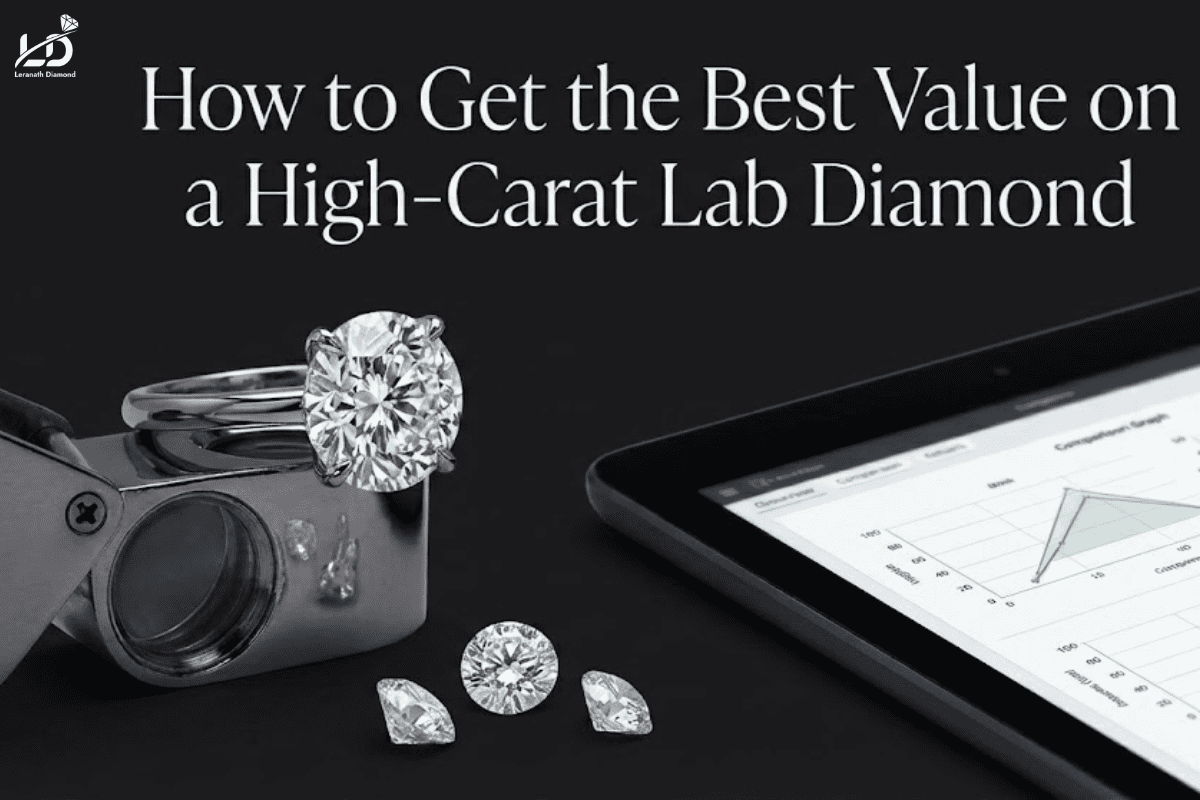
If you are not accustomed to it yet, choosing a high-carat diamond can be a daunting task as you will have to keep an eye on the size, quality, and cost. The introduction of lab-grown diamonds has completely changed the scenario by providing beautiful stones at a price lower than a raw diamond’s cost. The question now is, how to ensure that the largest lab diamond you are purchasing is the one with the best possible value? Let’s simplify the process into practical steps.
Understanding What Makes Lab Diamonds Affordable
Lab-grown diamonds and natural diamonds have the same chemical composition. They contain pure carbon with carbon atoms arranged in the same crystal structure, hence they have the same appearance, brilliance, and life span as the earth-mined ones. But, the only difference is the origin: an artificial environment instead of a natural one.
This difference plays a significant role in the costs. Usually, lab diamonds are priced 60–80% less than their mined counterparts of the same weight and quality. If you are purchasing a diamond in the 2-carat, 3-carat, or even larger category, the price difference will be quite noticeable. For example, a 3-carat lab diamond might cost the same as a 1-carat natural diamond with comparable quality.
Focus on the Right Quality Factors
Not all diamonds are created equal, and understanding the 4 Cs will help you spend your money wisely.
Cut Comes First
- Cut determines how much fire and brilliance your diamond displays
- A well-cut diamond appears more luminous and attractive than a poorly cut one with similar other characteristics
- Prioritize excellent or ideal cut grades for best value
- This is where your diamond gets its “wow factor”
- The money saved by choosing a lower cut grade is not worth the loss in visual appeal
Color: Go Near-Colorless
- Colorless diamonds (grades D, E, F) are the most expensive
- Most people cannot distinguish between colorless and near-colorless (G, H, I) grades
- Choosing a G or H colored diamond offers significant savings
- No noticeable difference in appearance to the untrained eye
Clarity: Nobody Needs Perfection
- This is where you can achieve the biggest savings
- Flawless diamonds are beautiful but extremely expensive
- Inclusions invisible to the naked eye don’t affect the diamond’s appearance
- SI1 or SI2 clarity grades are often excellent choices
- Well-cut stones can hide tiny imperfections with their sparkle
- Always inspect the diamond personally or request high-quality photos
Carat Weight: Shop Smart
- A 1.9-carat diamond costs considerably less than a 2-carat, but the 0.1-carat difference is undetectable when worn
- Carat measures weight, not size perception
- Choose diamonds slightly below popular carat weights for better value
Choose the Right Shape for Your Budget
Round brilliant diamonds are the most popular, but they’re also the most expensive because they require cutting away more rough material. If you’re flexible on shape, consider oval, cushion, or emerald cuts. These fancy shapes can be 20-40% less expensive than rounds for the same carat weight, and many people find them even more distinctive and attractive.
Get Certified, But Don’t Overpay for the Name
You should always purchase a diamond that is certified by an excellent grading lab. IGI (International Gemological Institute) and GIA (Gemological Institute of America) are both great when it comes to laboratory diamonds. IGI in particular is now well established in the lab-grown diamond market and gives you the best value for your money with its low-cost grading service, which can lead to savings for you.
Avoid diamonds without certification. You need that independent verification to know you’re getting what you pay for.
Compare Multiple Retailers
There is a huge difference between the prices of lab diamonds sold by different vendors. Some online jewelers have a much lower overhead, and they are able to give their customers a better price. Don’t make your purchase in the first shop you visit. Try at least three different retailers and don’t be afraid to ask if they can match or undercut the price of a competitor on a similar stone.
Many retailers also offer virtual appointments where experts can show you diamonds via video call. This is a great way to see exactly what you’re getting without visiting multiple stores.
Consider Setting Costs Too
The overall cost of the diamond will be higher as a larger diamond requires a more substantial setting. If you are really planning to spend the money on a big stone, then it must be that you will be needing a setting that is strong enough to hold it securely. Occasionally, going for a slightly smaller diamond might give the option of investing in a more exquisite setting that will enhance the beauty of the whole look.
Timing Can Matter
Like many retail items, diamond prices can fluctuate. Shopping during off-peak seasons (avoiding November through February, when engagement ring shopping peaks) might give you more negotiating power. Holiday sales and promotional periods can also offer genuine savings.
Ask About Upgrade Programs
Some jewelers offer upgrade programs where you can trade in your lab diamond later toward a larger one. If you think you might want to go bigger in the future, this can provide valuable flexibility. Just read the terms carefully to understand any restrictions.
The Bottom Line
Getting the best value on a high-carat lab diamond comes down to being strategic. Prioritize cut quality above all else, choose near-colorless over colorless, be flexible on clarity, consider shapes other than round, and shop around. Lab diamonds have made it possible to own stunning, large stones without devastating your savings.
Remember that the “best” diamond isn’t the most expensive one-it’s the one that looks beautiful to you and fits comfortably within your budget. With lab diamonds, you can have both size and quality without compromise.